I don’t partake in this whole “nerds vs. normies” discourse. It’s reductive and often amounts to little more than gatekeeping. Heck, I love it when people I would never in my wildest dreams imagine to be members of “my tribe” get enthusiastic about the zany stuff I like.
Yet a little comic called Blue Box (Aoi no Hako) toes the line of my convictions.
This romance manga by Kouji Miura, which has been published in Weekly Shounen Jump since 2021, is gormless and mundane in a way that almost feels deliberate. The only aspect of it that could even remotely be called “provocative” is its insistence on having so little edge it makes the often generic boy-scout battle manga accompanying look like Berserk in comparison. Many critics have highlighted this as Blue Box‘s main draw, but to me, it almost feels like a betrayal. Blue Box seems as if it wasn’t written for anyone who would reasonably read Jump, or even read, period.
Reading has, after all — and I mean this in the best way possible — always been for freaks. People who love imagining and empathizing with others, even beyond the boundaries of what is real or realistic. People who aren’t afraid to let their emotions wash over them, and who want more than what they’re getting in life. In essence fiction, is not concerned with what is normal. even realistic fiction depicts situations and emotions that deviate, or at least are expressed in a way that deviates, from what we experience in our everyday lives. If all we wanted was what we already know, we wouldn’t be reading, watching or playing.
This simple fact makes real normalcy uncanny, in the way stock photos or family insurance commercials are uncanny.
It’s no wonder then that the average manga protagonist, from the shounen hero ostracized by his peers to the shoujo heroine unable to properly express herself, is some sort of freak. A weirdo. An outsider. Someone who deviates from what society deems normal, be it in looks, status, ability, personality, social standing, or whatnot.
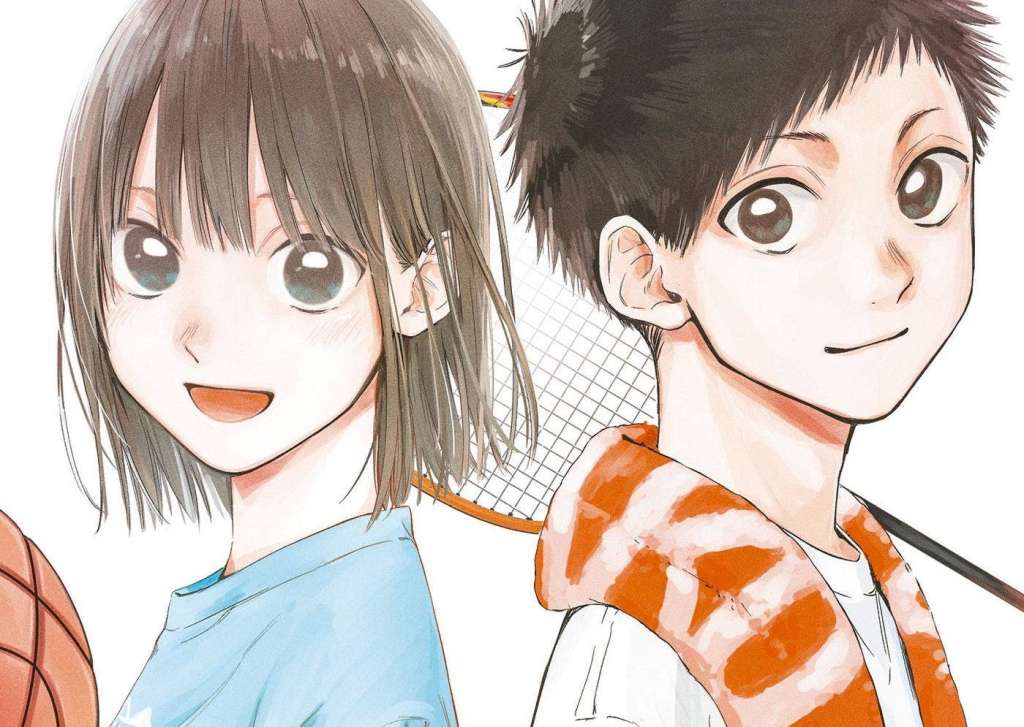
Blue Box‘s Taiki Inomata, however, is not a freak. If anything, he is what people think of when they imagine someone who isn’t a freak. He’s a moderately popular jock, satisfied in life, good at badminton and blessed with a large group of friends. He has no personality traits aside from “likes badminton” and no flaws aside from “likes badminton too much.” He has an adorable but entirely vapid crush on a girl on the basketball team because she just likes basketball so much.
This, oddly enough, makes him lose all credibility as a protagonist. After all, the reason why fiction is so universally appealing is because it shows us a deviation from the normalcy we as a society have decided to enforce. Blue Box is not a deviation, an as a result is incapable of having the appeal fiction normally has.
Taiki, unlike the rest of us, is not a freak. We don’t need anyone to tell us about Taiki, because Taiki is the guy we think of when we think of “a guy”. He is hyperreal, nothing but a chimera of socially acceptable traits, an embodiment of an ideal no actual person even comes close to attaining. As a result, his normalcy is off-putting. He is supposed to be everyone, but in the end, he is absolutely no one.
Then again, not all fiction is about supposed freaks. Manga especially tend to cart out deliberately generic protagonists so audience members can relate to them. Those manga, however, are also for freaks. The freak factor simply doesn’t come from the viewpoint character, but from the people surrounding them. If fiction isn’t about freaks, it sure as heck will try to appeal to them.
I’m not saying that’s always a good thing. In manga, especially, this often leads to misogynistic clichés or pandering to inclinations that shouldn’t be pandered to. We should look at the bigger picture, however. Once again, it’s the deviation from the norm that matters, and once again, Blue Box has nothing to show for it. Taiki’s crush, Chinatsu Kano, is — stop me if you’ve heard this before — a moderately popular jock, satisfied in life, good at basketball and blessed with a large group of friends. She has no personality traits aside from “likes basketball” and no flaws aside from “likes basketball too much” and over time, she develops an adorable but entirely vapid crush on Taiki because he — you guessed it — just likes badminton so much.
Two normal people, normally falling in love.
It’s not just in this characterization that Blue Box makes no efforts to find the flimsiest sliver of freak appeal in any of its parts, however. The actual narrative itself as well is constructed entirely from inoffensive normalities that safely steer clear from anything that could be accused of having been in a room together with “messy”. Training camps. Culture festivals. Rivalries with less edge than a sphere. Yawn.
Blue Box is so terrified of being accused of freakiness, it ends up being saccharine and boring. Despite their romance being the thing the entire story revolves around, Taiki and Chinatsu don’t get to know each other better, because there is nothing to learn. These characters are too normal to contain multitudes, too normal to be flawed, too normal to clash with others over anything worse than a misunderstanding.
So when the two eventually, inevitably, hook up, it’s as if Blue Box short-circuits, unable to reconcile its entire raison d’être — teen romance, a fundamentally messy, freakish thing — with its seething disdain for everything you wouldn’t find in a brochure for a suburban gated community. Then again, I don’t crave any payoff for the agonizing crawl it took Blue Box to get there. There were never any stakes, so why would I care about this barely-a-relationship?
The answer is “because I’m expected to”. Blue Box is so obsessed with being normal, being broadly appealing, being relatable, being completely devoid of “ew, gross, weird” that it ends up feeling alien. It’s not a manga for people who read manga. It’s a manga for whatever people who read manga think people who don’t read manga are like.
You know what, though? That’s a bummer. Kouji Miura is undoubtedly a fantastic illustrator, with a detailed pen, an expressive style, an eye for gorgeous page layouts and even the ability to credibly depict the young badminton players, basketball stars and rhythmic gymnasts that make up Blue Box‘s cast in the heat of their big moments.
Unfortunately, her efforts are entirely in vain, because her writing doesn’t have the chops to back any of that up. Blue Box has no themes, no motifs and no morals, aside from the inexplicable craving to be “normal”. In that craving, however, it forgets “normal” only exists by virtue of people who aren’t “normal”. “Normal” is the biggest fiction of them all, and that, paradoxically, makes it entirely unwelcome in the world of fiction.
After all, fiction is for freaks. That’s why it is for everyone.


 Retroversy
Leave a comment