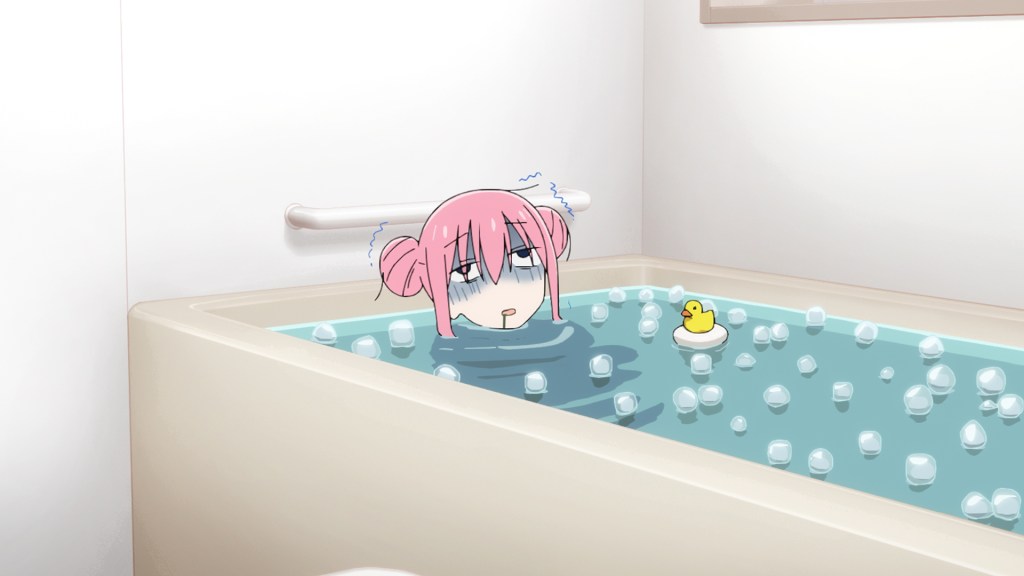
Shout-out to the people adapting Bocchi The Rock! into an anime, who saw this scene from Chapter 4 of the manga being used for vaguely creepy fanservice — including the weird detail that Bocchi, a character usually seen in a shitty tracksuit, wearing frilly lingerie all of a sudden — and just tossing out the nudity in favour of black comedy.
It’s awfully refreshing to see an anime adaptation reject some of its source material’s nastier impulses, and pursuing its own vision. Heck, director Matthew Vaughn basically built his entire career on this very idea. It’s noticeable here, however, because anime adaptations, often little more than glorified ads for the manga they are based on, often have no incentive to cast a critical eye on their source material. The only reason why Bocchi The Rock! went from a cookie-cutter Manga Time Kirara-style slice-of-life manga about cute girls doing cute things to a hysterical black comedy, is because of the people adapting it wanted to enforce their creative vision.
Don’t get me wrong, all the jokes that work so well in the anime are still in the original manga, so credit where it’s due. They just completely miss the mark in their original form because the manga feels obligated to stick to the conventions of its medium. The 4-koma format is detrimental to the comedy’s pacing, and the unwritten rule that its characters need to be desirable moeblobs kneecaps its potential for being truly relatable. The anime, on the other hand, either doesn’t or isn’t forced to care about these conventions, making it all the stronger as a result.
In a way, that makes Bocchi The Rock! the exact inverse of this season’s Chainsaw Man. Whereas Bocchi The Rock! is lauded, Chainsaw Man — while certainly not a disgrace — is being criticized by many for the choices it made in adapting the source material. It’s hard not to see why. Chainsaw Man is being bogged down by the expectations that come with being, y’know, the highly anticipated adaptation of a manga that was already selling millions of copies before the anime even got announced. Because of these expectations, studio MAPPA ended up making the choice to turn it into a high-budget, cinematic prestige project. This, however, was the wrong choice.
The Chainsaw Man anime we are now getting was designed to adhere to the conventions a “prestige story”: muted colors, sweeping cinematography and a tight focus. The Chainsaw Man manga, on the other hand, was lauded for its complete disregard for any kind of such rules. It is grimy, grungy and anarchic in its sense of style and pacing. In other words, the Chainsaw Man anime has a lot of boxes to tick, whereas its manga had little to none. Bocchi the Rock, on the other hand, lost all of the shackles it has as a manga when it got turned into an anime. It is the clear result of an ambitious, but inexperienced director getting to do what they want with an IP no one really seemed to give a toss about. Furthermore, it is proving that this ambition might even be more important in turning your adaptation into a success than the strength of the source material.


 Retroversy
Leave a comment